Confined to
Culture.
In 2022 a Melbourne company grew human neurons on a chip, taught them to play Pong, and called them sentient in the title of its paper. When the cells missed the ball, they got four seconds of random electrical noise, or total silence. Since March 2025 the system has been on sale for about US$35,000. Canada has three rulebooks that could reach work like this. TCPS 2 protects the person who gave the cells. The Assisted Human Reproduction Act protects the embryo. The Canadian Council on Animal Care protects the animal. Not one of them is written for the neurons in the dish. The animal rule goes further: it tells researchers that failing to move work off animals and into a dish is unethical.
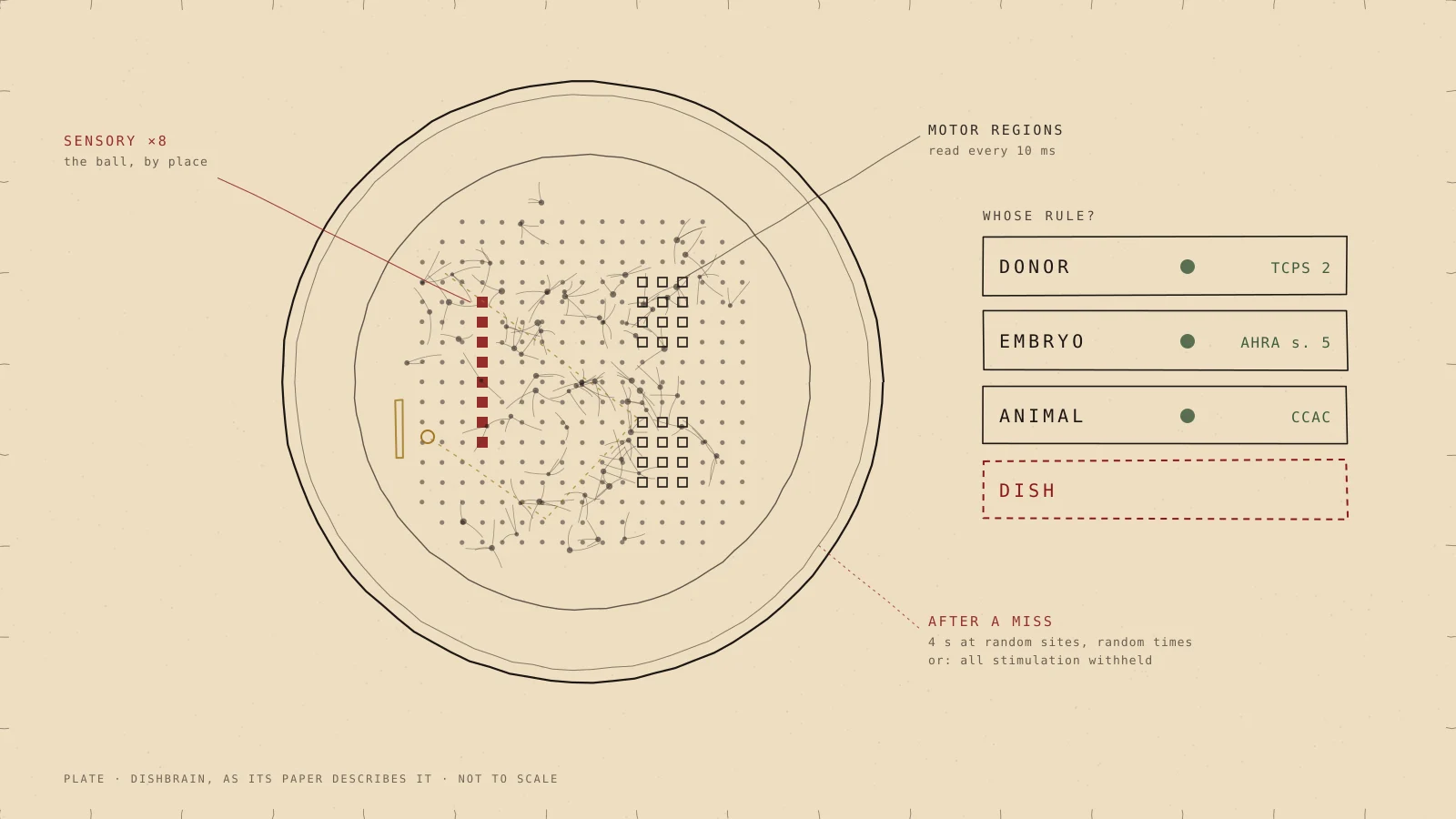
Pong, eight electrodes
and four seconds of noise, 2022.
In December 2022 the journal Neuron printed a paper from Cortical Labs, a company in Melbourne, and its academic partners. Its title was “In vitro neurons learn and exhibit sentience when embodied in a simulated game-world.” The team grew neurons on a high-density electrode array. Some came from the cortex of mouse embryos taken at fifteen and a half days. Others were grown from human induced pluripotent stem cells, which are made by reprogramming an adult’s skin or blood cells. The paper calls the system DishBrain.
The game was Pong. Eight electrodes on one side of the culture told it where the ball was. The software counted spikes in two “motor” regions every ten milliseconds and moved the paddle up or down with them. The human cultures were kept on the arrays for more than three months.
The cells were trained with what they received after each point. A hit brought a burst of predictable stimulation. A miss brought four seconds of stimulation at 150 millivolts and 5 hertz, delivered “at random sites at a random timescale” across the eight inputs. In a second experiment the miss was answered differently: “a matching time period in which all stimulation was withheld.” Both kinds of feedback beat no feedback at all, and the random noise worked best. The theory behind the design is the free energy principle: a nervous system acts to keep its input predictable, so it will work to avoid whatever makes its input unpredictable.
The authors proposed that their cultures met “the formal definition of sentience as being ‘responsive to sensory impressions’”. In March 2023 Neuron printed a reply from about thirty neuroscientists, “A response to claims of emergent intelligence and sentience in a dish,” and the authors’ answer beside it. The argument was over the word. No one disputed the protocol.
For sale and for rent,
2023–2026.
In April 2023 Cortical Labs raised US$10 million. Horizons Ventures led the round. Blackbird Ventures, LifeX Ventures and Radar Ventures came in, and so did In-Q-Tel, the venture arm of the CIA. The company said it was already filling orders.
In March 2025 it announced the CL1, which it calls “the world’s first code deployable biological computer”: living human neurons on a silicon chip in a box that keeps them fed, for about US$35,000. Buyers can send code straight to the cells. The cultures were advertised to last up to six months. Anyone who does not want the box can rent cultures remotely through the company’s Cortical Cloud, which it calls “Wetware-as-a-Service”. The first units shipped that summer.
The neurons start as skin or blood cells given by adult volunteers, the company’s chief executive among them. That is where the ethics of this product has been argued: the donors consented, no embryo was used, no brain tissue was taken. All three statements are true. None of them is about what is done to the culture once it is alive and wired to a game.
TCPS 2, Chapter 12:
a rule written for the person.
In Canada, research with human cells funded by the three federal research agencies runs under the Tri-Council Policy Statement: Ethical Conduct for Research Involving Humans, TCPS 2, in its 2022 edition. Chapter 12 covers human biological materials, and its Section F covers stem cells. It has a national committee for the sensitive cases, the Stem Cell Oversight Committee.
Article 12.10 sets out what that committee sees: research with pluripotent stem cells “that have been derived from an embryonic source, and/or that will be grafted or transferred in any other form into humans or non-human animals.” Then it says what the committee does not see: “SCOC does not review research involving human pluripotent stem cells that come from somatic (non-embryonic) tissue and that are not going to be transferred into humans or non-human animals.” Neurons grown from an adult’s skin and kept on a chip are exactly that research.
What is left is the ordinary research ethics board, and everything Chapter 12 asks that board to check concerns the donor: consent, privacy, whether the cells can be traced back to the person, and conflicts of interest. Article 12.16 even makes room for a donor to give cells to a named project, because “induced pluripotent stem cells are not derived from human embryos.” The 2022 edition of TCPS 2 runs to 288 pages. The words organoid, neural, sentience and moral status appear in it zero times.
The Assisted Human Reproduction Act:
a rule written for the organism.
Parliament’s own law on human biology in the laboratory is the Assisted Human Reproduction Act of 2004. Section 5 is a list of crimes: no one may create a human clone, create an embryo in vitro except to make a human being or to improve fertility treatment, keep an embryo alive outside the body past its fourteenth day, make heritable changes to the human genome, or “create a chimera”.
Every one of those offences turns on one definition. Section 3: “embryo means a human organism during the first 56 days of its development following fertilization or creation.” A sheet of neurons on an electrode array is not an organism and is not developing into one. The Act was written to stop anyone making a person in a laboratory. It does not reach human brain cells that will never be a person.
The Canadian Council on Animal Care:
a rule that sends the work to the dish.
Canada’s animal-research oversight is the only one of the three built around sentience. The Canadian Council on Animal Care’s Ethics Principles for Animal Use in Science, published in March 2026, apply “to any animal where there is sufficient evidence that they are sentient,” and record that sentience “has been generally assumed for all vertebrate animals following birth or hatching.” Its test is the capacity to suffer, not where the cells came from.
Its scale runs from Category A to E. Category A, the bottom, is “Methods used on most invertebrates or on live isolates,” and the first example it gives is “the use of tissue culture.” Protocols must go to an animal care committee for work in Categories B through E. Category A is the one class that rule does not send for review.
Then the same document points the work at the dish. “Failing to replace animals whenever possible is unethical,” it says. “Where non-animal approaches can be substituted, it is expected that the use of animals will be refused.” The one Canadian rule that asks whether a nervous system can suffer moves research toward living human neurons in culture, which it does not cover.
Four subjects,
one question: whose rule?
Each panel is one of the four things in the DishBrain experiment that a Canadian rule might protect. Tap one and read the rule that reaches it, in its own words.
Read across the four and the gap is plain. Each rule is triggered by a source: a person, an embryo, a living animal. None is triggered by what the cells do once they are grown, how they are stimulated, or how long they are kept alive. The international stem-cell guidelines say the same in one line: “there is no biological evidence to suggest any issues of concern, such as consciousness or pain perception with organoids corresponding to CNS tissues, that would warrant review.” The company that sells the system put the word sentience in the title of its paper.
McGill, Calgary
and a learning rule, 1949–2010.
The idea that a culture of neurons can learn has a Canadian origin. In 1949 Donald Hebb, a psychologist at McGill, published The Organization of Behavior, which set out the rule that connections between neurons strengthen when the neurons fire together. The DishBrain paper places its work after earlier results in “state-dependent Hebbian plasticity”, named for him.
Two years after the book, Hebb took a secret Defence Research Board contract, X-38, to study what happens to a human mind when its input is held constant. His subjects were paid student volunteers in a cubicle with translucent goggles, tubes over their arms and the hum of a fan. They hallucinated, thought less clearly, and became measurably more open to persuasion. They had consented, and they could stop and walk out of the cubicle. The work went to the CIA and all three branches of the American military. It is told in full at Contract X-38.
Canada also built the chip. In August 2010 the University of Calgary and the National Research Council announced a “neurochip” from the laboratory of Naweed Syed that grows a network of brain cells on silicon and records them, a line of work the lab had begun by proving that brain cells reconnect on a chip. It was presented as a tool for screening drugs.
No Canadian institution has announced that it bought a CL1. If one does, its research ethics board will check the consent of the person who gave the blood. No Canadian rule asks anyone to look at what is done to the neurons.
The log,
from the learning rule to the rental.
Sixteen entries, each fixed by a document. The hinge rows are where a rule drew its line.
Back on deck:
what the log supports.
The donor. TCPS 2 protects the person who gives the skin or the blood: consent, privacy, conflicts of interest. Its national stem-cell committee steps aside by name for cells grown from adult tissue and kept out of bodies. Not one word of it concerns what is done to the neurons those cells become.
The embryo. The Assisted Human Reproduction Act protects a human organism in its first fifty-six days. A culture on a chip is not an organism, and the Act never reaches it.
The animal. The Canadian Council on Animal Care protects anything with enough evidence of sentience, assumes it for every vertebrate after birth, puts tissue culture in its lowest category, and calls it unethical not to replace animals with methods like it.
The dish. Human neurons that learn from the stimulation they are given, that their makers describe as sentient, that are trained with random noise and silence, and that are sold for US$35,000 a unit or rented by the week, fall under none of the three. Canada’s rules are keyed to where the cells came from, and never to what is done to them.
The donor signed a consent form and went home.
The mouse has a committee, and the rule tells the lab to replace it.
The neurons in the dish have no committee.
Where to check
every line above.
Grouped by the section each one supports.
i. The dish
DishBrain and the dispute over the word
- Brett J. Kagan et al., “In vitro neurons learn and exhibit sentience when embodied in a simulated game-world”, Neuron 110(23), 2022, doi:10.1016/j.neuron.2022.09.001: the mouse and human cultures, the eight sensory electrodes, the ten-millisecond readings, the 150 mV, 5 Hz, four-second random feedback, the Silent condition, the free energy principle, “responsive to sensory impressions”, cultures kept more than three months.
- Fuat Balci et al., “A response to claims of emergent intelligence and sentience in a dish”, Neuron 111(5), 2023, doi:10.1016/j.neuron.2023.02.009; Brett J. Kagan et al., “Scientific communication and the semantics of sentience”, Neuron, 2023, doi:10.1016/j.neuron.2023.02.008.
ii. The product
The round, the CL1, the rental
- “Cortical Labs raises $10M”, TechCrunch, 19 April 2023: Horizons Ventures, LifeX, Blackbird, Radar and In-Q-Tel, “the venture arm of the CIA”.
- Cortical Labs, CL1; PCWorld, 12 March 2025: “code deployable biological computer”, about US$35,000, up to six months, Wetware-as-a-Service. Cortical Labs, Wikipedia: shipping in summer 2025, cells from volunteers’ skin or blood, the chief executive among the donors.
iii. The donor
TCPS 2 (2022)
- Canadian Institutes of Health Research, Natural Sciences and Engineering Research Council and Social Sciences and Humanities Research Council, Tri-Council Policy Statement: Ethical Conduct for Research Involving Humans, Chapter 12, 2022 edition: Section F, the scope of the Stem Cell Oversight Committee, Articles 12.10 and 12.16.
- The complete 2022 text (PDF), searched for “organoid”, “neural”, “sentien” and “moral status”: no occurrences.
iv. The embryo
The Assisted Human Reproduction Act
- Assisted Human Reproduction Act, S.C. 2004, c. 2: section 3, the definitions of “embryo” and “chimera”; section 5, the prohibited activities.
v. The animal
The Canadian Council on Animal Care
- Canadian Council on Animal Care, Ethics Principles for Animal Use in Science, March 2026: section 1.3 on sentience, the Three Rs, and Principle of Application 3.
- Canadian Council on Animal Care, Categories of Invasiveness in Animal Experiments: Category A and the review requirement for Categories B through E.
vi. The instrument
The international guideline
- International Society for Stem Cell Research, Guidelines for Stem Cell Research and Clinical Translation, 2021 and updates: Category 1A and the note on organoid research.
vii. The Canadian line
McGill and Calgary
- D. O. Hebb, The Organization of Behavior: A Neuropsychological Theory, Wiley, 1949. W. H. Bexton, W. Heron and T. H. Scott, “Effects of decreased variation in the sensory environment”, Canadian Journal of Psychology 8(2), 1954. Contract X-38 and its record: x38.felineunion.org.
- University of Calgary, “Neurochip technology developed by Canadian team”, 10 August 2010.
Visual direction after the oceanographic films of Jacques-Yves Cousteau and the crew of the R.V. Calypso, 1943–1996. The saucer is the SP-350 “Denise”. No affiliation; the debt is the point.