Selected for
Settlement.
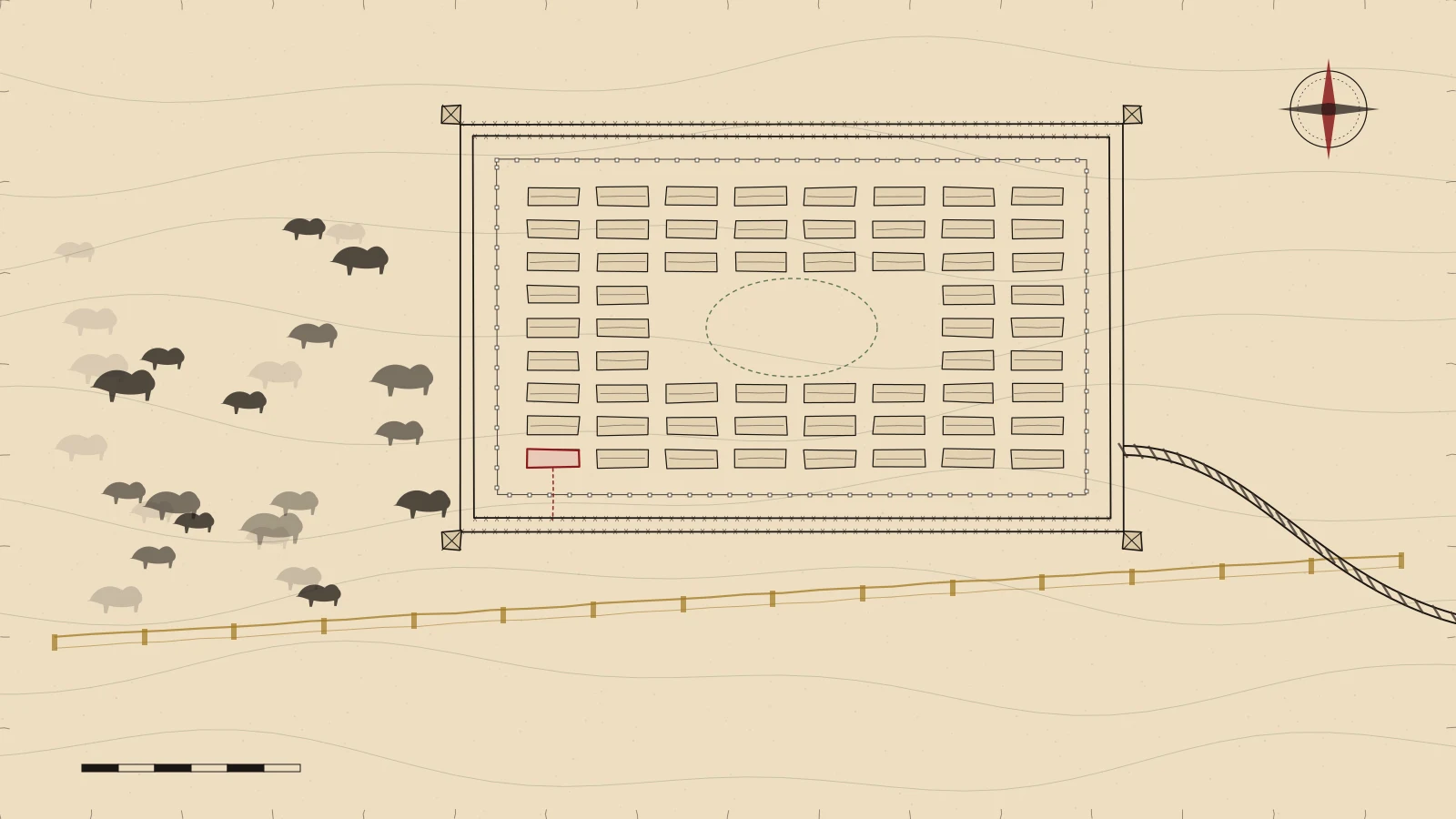
Canada held about 34,000 German prisoners of war for Britain, and the largest camps in North America stood in Alberta. The officers at Camp 135 were held at Wainwright, on a national park that had been emptied of its bison for the army. In December 1946 Ottawa drew up lists of prisoners “politically reliable and whose retention would have economic utility in the country”, cleared 745 in under a week, and sixteen days later sent every one of them back. Four years on, the door reopened by an order kept confidential for two weeks, and the bar on former Nazi party members went with it. Through all of it, a First Nation could not raise a dollar to bring a claim over its own land without the permission of the Department of Indian Affairs. Ottawa selected former enemies for settlement while the original owners of the land were kept out of court.
Britain’s prisoners,
Canada’s wire, 1940–1946.
In June 1940, with an invasion of Britain expected, London asked Ottawa to take 4,000 civilian internees and 3,000 German prisoners of war. Canada agreed. The first ships, the Duchess of York, the Ettrick and the Sobieski, crossed that summer; a fourth, the Arandora Star, was torpedoed on 2 July. The men were sent as dangerous enemy aliens. About 2,300 of them were refugees from Nazism, most of them Jews, and they were held behind the same wire as the Nazis they had fled until their release, one case at a time, between 1941 and 1943.
The real prisoners kept coming: aircrew, U-boat crews, then the Afrika Korps. By October 1944 Canada held nearly 34,000 of them. The two biggest camps in North America were built in Alberta, at Lethbridge and Medicine Hat, each for 12,500 men. The other Alberta camps were smaller and specialised. Officers went to Seebe in the Kananaskis, and from 1945 to Wainwright.
They were never Canada’s prisoners. Britain was the detaining power and repaid Canada for their keep under an agreement of October 1940. Humphrey Mitchell, the Minister of Labour, put it plainly in the Commons on 7 June 1946: “These are not our prisoners of war but men who were taken prisoner by the British forces. We merely acted as custodian.”
Inside the wire, the camps had a Nazi problem of their own. Canadian intelligence graded every prisoner white for anti-Nazi, black for committed Nazi, and grey for the rest, and Lethbridge and Medicine Hat were counted black camps. At Medicine Hat, prisoners beat and hanged a fellow prisoner, August Plaszek, on 22 July 1943, and a teacher, Karl Lehmann, on the night of 10 September 1944. Five of the killers were hanged in the Lethbridge jail in 1946, four of them together on 18 December. It was the last mass execution in Canada.
The ground under the camp,
1908–1940.
Camp 135 stood on what had been Buffalo National Park. It was set aside by Order in Council on 7 March 1908, about 160 square miles of rolling country south of Wainwright inside Treaty 6, to hold a herd that Ottawa bought from Michel Pablo in Montana. That herd had its own history of a taking. It had grown on the Flathead Reservation, and Pablo sold because the reservation was being thrown open to settlement. From 1909 to 1912, 748 bison went into the Wainwright park.
They multiplied past what the land could carry, to 8,832 animals in 1925–26, and they were sick. When the first cull came, in the winter of 1923, three in four of the 264 animals killed carried tuberculosis. The department kept it quiet; in the words of its own historian, the disease “was withheld from public knowledge as a matter of departmental policy”. Then it shipped 6,673 young bison north to Wood Buffalo National Park between 1925 and 1928, without the test a Parks Branch officer, Hoyes Lloyd, had asked for. He called the decision “very bad epidemiology”. The plains bison bred into the wood bison there, and bovine tuberculosis and brucellosis, which the transfer is believed to have brought in, are still named in federal recovery documents as the leading threat to the wood bison.
The war ended the park. In October 1939 a branch director wrote that this was “the first opportunity we have had to wind up affairs at Wainwright without admitting publicly that the herd is in bad condition”. By early 1940, 2,918 bison, 1,806 elk, 113 moose and 242 deer had been killed. An Order in Council under the War Measures Act on 19 March 1940 let National Defence occupy the park, and the army took formal possession on 30 September 1940. Thousands of Canadian soldiers trained there until 1944. Parliament abolished the park on 17 July 1947.
Camp 135, Wainwright,
29 January 1945 to 14 June 1946.
The camp was opened in a hurry. In October 1944 the army learned of an escape plot at the Grande Ligne camp in Quebec, with sabotage planned against local industry, and wanted its leaders moved to Seebe, the secure officers’ camp in the mountains. Seebe’s officers had to go somewhere. The empty training centre at Wainwright already had barracks, messes and a hospital, and it was fenced. The first 523 prisoners arrived from Seebe on 29 January 1945, by the camp’s war diary 403 officers, 105 other ranks and 15 civilians. More came from Gravenhurst, Bowmanville and Grande Ligne, and the count peaked at 1,094 on 12 April 1945. On 30 June 1945 the ration strength was 1,086, of them 787 officers.
These were not conscripts picked up in a hedgerow. Most had already spent years in other camps. They raised orchestras and ten football teams, enrolled about 700 men in winter courses, and from 2 April 1945 went out on parole walks, picking berries and skiing in the grounds of the abolished park after signing a promise to return. Some never stopped trying to leave. On 19 March 1945 two lieutenants, Klaus Conrad and Meuche, walked out through the gate as a wire-repair party, in civilian clothes cut from blankets under overalls a prisoner tailor had made from mattress ticking. They were arrested about a month later in Gary, Indiana. On 18 April the camp removed an officer, Gundlach, because “his life was in danger from other PW”. On 27 April a search of Hut 18 found a tunnel twenty feet long, running toward the wire from a shaft eight feet down.
The war in Europe ended with the prisoners at Wainwright still behind the wire. By the historian Michael O’Hagan’s count from the camp’s records, by February 1946 about half of them were graded grey, the rest split between white and black, and about a quarter hoped to stay in Canada. One, Oberleutnant Hans Bauermeister, asked a Canadian guard officer, Leo Hamson, to help him do it. Hamson told him the prisoners would have to go back into British custody first, and could join the queue from there. On 8 May 1946 the war diary noted that the remaining prisoners were “still anticipating a return to their homeland”. The drafts went out under one heading: PW to U.K.
The four logged drafts account for 950 men; the rest of the camp left in transfers the published excerpts of the diary do not itemise. The last train left the camp spur at 6:40 in the evening of 24 May 1946 with 250 officers and 25 other ranks. The diary’s next line reads “This leaves Camp 135 at Nil PW strength.” The army kept the site. It is CFB Wainwright today, home of the Canadian Manoeuvre Training Centre, and one of the camp’s guard towers still stands on it.
Politically reliable, economically useful,
3 to 19 December 1946.
Ottawa did not want them all to go. On 5 April 1946 Canada asked Britain to leave it 3,500 German prisoners as farm labour, above all for the sugar-beet fields. Britain refused. By May, officials were reluctant to see the rest leave, because the farms needed them. In September, of the 4,207 still in Canada, 60 per cent were reported to want very much to stay, and over the year more than 6,000 prisoners put that request in writing.
Cabinet took it up on 3 December 1946. The Prime Minister reported that about 2,000 German prisoners still in Canada would be moved to Britain late in December, and that “numerous representations had been made that a selected group of these men be allowed to settle in Canada, on the grounds that they were potentially useful for industries such as lumbering and agriculture.” Cabinet agreed that, if London concurred, up to 200 prisoners selected in the manner proposed could stay on the same terms as the Polish veterans then arriving to work on farms.
A week later the departments came back with lists. Officials had picked out the men “considered politically reliable and whose retention would have economic utility in the country”: some 745, of whom 738 had volunteered to remain. External Affairs asked for more than 200. On 10 December Cabinet held the line at 200, single men only. Military intelligence had cleared those men in less than a week. The Deschênes Commission’s historian, Alti Rodal, asked in 1986 what kind of screening was possible in so short a time.
Then it leaked. On 18 December the Lethbridge Herald reported that 200 prisoners who had asked to remain would undergo “a period of trial citizenship”, and Cabinet noted that “unauthorized publicity” had brought objections. The Canadian Legion had already resolved against any German prisoner staying. Alberta’s premier, Ernest Manning, called the plan “nothing short of fantastic”. On 19 December Cabinet agreed that “the retention of any group of prisoners of war in Canada would not be justified and that all should be returned forthwith”, leaving room only for “individual cases upon compassionate or other grounds”. The first cases named for that review were the prisoners who had testified at the Medicine Hat murder trials.
On 22 December the liner Samaria sailed from Halifax and landed 2,123 German prisoners at Liverpool a week later, most of them from Lethbridge. On 2 January 1947, fifty more sailed on the Aquitania, with 150 still waiting. Rodal, writing from the files forty years later, took the December lists as men who had stayed. The minutes show that Cabinet refused to enlarge the list and then cancelled it.
Two doors,
1927 to 1962.
One door is the way into Canada for a German former enemy. The other is the way into court for a First Nation with a claim to its own land. Every stage below is a date from the record. Drag through them and watch which door is open.
Read across the stages and the timing carries the finding. Ottawa spent December 1946 sorting enemy prisoners by their use to the economy. It reopened the country to Germans in September 1950, and that year it stopped treating Nazi party membership as a bar. First Nations were still forbidden to raise money for a land claim without the department’s consent, and remained so until 1951.
The door reopened,
1949–1962.
The refusal of December 1946 held for less than four years. Germans had been barred as enemy aliens since 14 September 1939. In September 1949 Cabinet agreed to consider their close relatives case by case. On 28 March 1950 an order admitted ethnic Germans who had not held German citizenship before the war, and German nationals with close family in Canada, and the minister directed that service in the German armed forces “as such not be a cause for rejection”. On 14 September 1950, eleven years to the day after the bar, Cabinet removed German nationals from the prohibited class. The historian Gerhard Bassler, working from the immigration files, records that the order “was, however, kept confidential for more than two weeks”. It appeared in the Canada Gazette on 29 September.
Screening went the same way. According to the Library of Parliament, until 1949 Canada had no criteria for rejecting either Nazis or the German military as immigrants. A ban on Nazi party members, the SS and the Wehrmacht came in 1949; “the Nazi prohibition was dropped in 1950.” Exemptions for Waffen-SS conscripts followed in 1951 and 1953, the general ban on German military and SS veterans was relaxed in 1956, and specific exclusions were removed altogether in 1962. The same year, 1950, Canada admitted the veterans of the Waffen-SS Galicia division, the subject of Inheritance Trace.
Former prisoners came back through that door. Siegfried Osterwoldt, an artillery lieutenant captured at El Alamein and held at Wainwright, went home to Germany, married in 1951, and sailed from Bremerhaven to Montreal in 1954; he became a land surveyor in Edmonton. Hans Pfeffel, the Wainwright tailor who cut the escapers’ overalls, returned in 1955, opened a clothing store in Coaldale and raised a family. Harry Pohl came back in 1951 to the southern Alberta farm where he had worked as a prisoner, and counted at least 36 others who returned to the region. Alfred Weiss bought the Picture Butte farm where he had been held. Siegfried Bruse ran a real-estate firm in North Bay. No government counted them; the one published estimate, a historian’s, is about a thousand of the 35,000.
Did any prisoner graded black come back? No record shows one admitted, and none shows the camp gradings being used to screen immigrants at all. After 1950 Nazi party membership on its own barred nobody.
The other door,
1927–1951.
In the 1920s, First Nations were taking their land to law. The Allied Indian Tribes of British Columbia, the Nisga’a Land Committee, the Six Nations Confederacy and the League of Indians of Canada had lawyers, and in 1926 the Allied Tribes asked Parliament to let them take a title claim for the whole province to the Privy Council in London. A joint committee of the Senate and the Commons heard them, dismissed the arguments and recommended that all future claims be refused.
In March 1927 Parliament added section 141 to the Indian Act. It made it an offence for anyone, Indian or not, to raise or receive money to pursue a claim on behalf of an Indian band without the permission of the Department of Indian Affairs. The government’s own summary today says the amendment “effectively prevented First Nations from pursuing land claims of any kind.” John Diefenbaker described it as providing “that Indians can have no recourse to the courts unless they have the permission of the minister to proceed.” The Allied Tribes dissolved.
Section 141 stood for twenty-four years. It was in force when the Pablo herd’s descendants were shot to clear the park, when the Wainwright land inside Treaty 6 became an army camp, when its prison held German officers on parole walks, and on the December days when Cabinet weighed which enemy prisoners were useful enough to keep. It was repealed in the new Indian Act of 1951, a year after the door for Germans reopened.
No record ties the founding of Buffalo National Park to the eviction of any band, and this volume does not claim one. The connection is the one the dates make. Through the same years, Ottawa ran two screens. One sorted enemy soldiers by what they could do for the country. The other kept the land’s first owners from hiring a lawyer to ask for it back.
The log,
from the bison to the last exclusion.
Twenty-two entries, each fixed by a document. The hinge rows are the ones where a door moved.
Back on deck:
what the log supports.
Selected. In December 1946 the federal Cabinet sorted German prisoners of war by two tests, political reliability and economic utility, and cleared 745 men in less than a week. Ottawa had already asked Britain for 3,500 more as farm labour. The intent to keep useful enemy soldiers is in the minutes, in the government’s own words.
Refused. It did not happen in 1946. Publicity, the Legion and Alberta’s premier turned Cabinet around in sixteen days, and the sailings, the British counts and the camp’s diary run to the same end: the camps emptied and the prisoners left, the Samaria alone carrying 2,123 of them to Liverpool. The record leaves no German officer from Wainwright in Canada when the camps closed.
Readmitted. They came back by the front door instead, once it was reopened in September 1950 by an order kept quiet for two weeks, in the same year the bar on Nazi party members was dropped. Some became farmers on the land where they had been held, surveyors, builders and real-estate men.
Blocked. Through every one of those years, section 141 of the Indian Act kept First Nations from raising money to bring a claim over their own land. It was lifted in 1951, one year after the Germans’ door. Ottawa was selecting former enemies for inclusion while it kept the original peoples from contesting the loss of their land.
The park was emptied quietly, and the prison was built on it.
The prisoners were sorted for their usefulness, sent away, and let back in by an order nobody was told about for two weeks.
The people whose land it was needed the department’s permission to hire a lawyer.
Where to check
every line above.
Grouped by the section each one supports.
i. The request
The 1940 request, the totals, the custodian
- Canadian War Museum, “Axis Prisoners in Canada”, Democracy at War: the June 1940 request for 4,000 civilian internees and 3,000 prisoners, and nearly 34,000 military prisoners by October 1944.
- David J. Carter, “Prisoner of War Camps in Canada”, The Canadian Encyclopedia, 2015: more than 34,000 combatant prisoners, held under British supervision; Lethbridge and Medicine Hat, 12,500 each, the largest camps in North America.
- Vancouver Holocaust Education Centre, Enemy Aliens: The Internment of Jewish Refugees in Canada, 1940–43: about 2,300 refugees from Nazism, most of them Jews. The National Archives (UK), “The loss of SS Arandora Star”.
- House of Commons Debates, 7 June 1946, p. 2294 (Humphrey Mitchell), via parl.canadiana.ca. Robin Stotz, Camp 132: A German Prisoner of War Camp in a Canadian Prairie Community, MA thesis, University of Saskatchewan: the October 1940 cost agreement, the white-grey-black grading and the Medicine Hat trials.
- UK House of Commons, written answers, 16 July 1946 (8,633 in Canada at 30 June) and 8 October 1946 (4,182 at 30 September).
- Provincial Archives of Alberta, Rex v. Mueller; “Gestapo PoWs”, Legion Magazine: Plaszek, Lehmann, and the hangings of 26 June and 18 December 1946.
ii. The park
Buffalo National Park, 1908–1947
- W. F. Lothian, A History of Canada’s National Parks, vol. IV, ch. 7 (Parks Canada): P.C. 463 of 7 March 1908, the Pablo purchase and the Flathead Reservation, the 1923 cull and the policy of silence, Hoyes Lloyd, the 6,673 shipped north, the memo of October 1939, the 1939–40 kill, P.C. 1036 of 19 March 1940, the takeover of 30 September 1940 and the abolition of 1947.
- Jennifer Brower, Lost Tracks: Buffalo National Park, 1909–1939 (AU Press, 2008): the herd counts and culls, season by season.
- Environment and Climate Change Canada, Recovery Strategy for the Wood Bison, 2018, and COSEWIC, assessment of 2013: the transfer and the diseases.
iii. The camp
Camp 135, 1945–1946
- Camp 135 War Diary, from CFB Wainwright, excerpts transcribed at can-esc.com, 2010: the arrivals of 29 January 1945, the count of 12 April, the escape of 19 March and the arrest in Gary, Gundlach, the tunnel of 27 April, the ration strength of 30 June 1945, the entry of 8 May 1946, the drafts and the nil strength. Leo Hamson’s recollections of Pfeffel and Bauermeister on the same site.
- Michael O’Hagan, “Camp 135 – Wainwright”, POWs in Canada: the Grande Ligne plot, the camp’s life, the gradings and the quarter who hoped to stay. The camp’s war diary dates the escapers’ arrest to April 1945.
- Department of National Defence, Wainwright history page (archived), and Detachment Wainwright.
iv. The selection
Cabinet, December 1946
- Cabinet Conclusions, 3, 10, 18 and 19 December 1946, Library and Archives Canada, RG 2, A-5-a, vol. 2639, on microfilm T-2364–T-2365.
- Alti Rodal, Nazi War Criminals in Canada: The Historical and Policy Setting from the 1940s to the Present, report to the Commission of Inquiry on War Criminals, 1986, pp. 140–141 (LAC record; transcription): the reluctance of May 1946, the 4,207 and the 60 per cent, the 745 and 738, and the question about the screening.
- Jordyn Bailey, MA thesis, Western University, 2019, citing Documents on Canadian External Relations vol. 12, p. 202 (the 3,500) and Henderson (1993), p. 92 (the 6,000 applications).
- Lethbridge Herald, 18, 20 and 30 December 1946 and 2 January 1947, University of Lethbridge digital archive: trial citizenship, Manning’s statement, the sailings of the Samaria and of the Aquitania. “The Happiest Prisoners”, Legion Magazine, 15 March 2012: the Legion’s 1946 resolution.
v–vi. The doors and the reopening
Immigration and screening, 1939–1962
- Gerhard P. Bassler, “Canadian Postwar Immigration Policy and the Admission of German Enemy Aliens, 1945–50”, Yearbook of German-American Studies: 14 September 1939, September 1949, 28 March 1950, the ministerial directive, and the order of 14 September 1950 kept confidential until 29 September.
- Library of Parliament, “War Criminals: The Deschênes Commission” (87-3E): the screening criteria from 1949 to 1962.
- Legion Magazine (above): Osterwoldt, Pohl and the 36, Weiss, Bruse. Osterwoldt’s obituary, from his memoir: Germany, 1951, Bremerhaven to Montreal in 1954. Canada’s History, “A German POW in Canada”: Bernard Wood’s estimate of about a thousand.
vii. Blocked
Section 141 of the Indian Act
- Crown-Indigenous Relations and Northern Affairs Canada, “First Nations in Canada”: the 1927 amendment and its repeal in 1951.
- Amy Swiffen, “How the Indian Act’s ‘blackout period’ denied Indigenous Peoples their legal rights”, The Conversation, 2022: the Allied Tribes, the 1926–27 committee, “every person”, and Diefenbaker’s words. Union of BC Indian Chiefs, historical timeline.
- Treaty No. 6, 1876.
Visual direction after the oceanographic films of Jacques-Yves Cousteau and the crew of the R.V. Calypso, 1943–1996. The saucer is the SP-350 “Denise”. No affiliation; the debt is the point.