The House
Edge.
People were not put to sleep by the feed. They were played, overruled and billed, and in October 2026 they went into the street. The tools that hold attention came from the casino floor, where the trade’s own measure is time on device, and by 2011 one game company supplied twelve per cent of Facebook’s revenue. Voters threw out government after government while the parties passed office among themselves: five of Britain’s last six prime ministers were chosen inside their party. Rent, food and schools sent the bill to people who never sat at the table, and on 17 October the town hall of Limoges burned. The crew dives off Monaco, where the house always takes its cut.
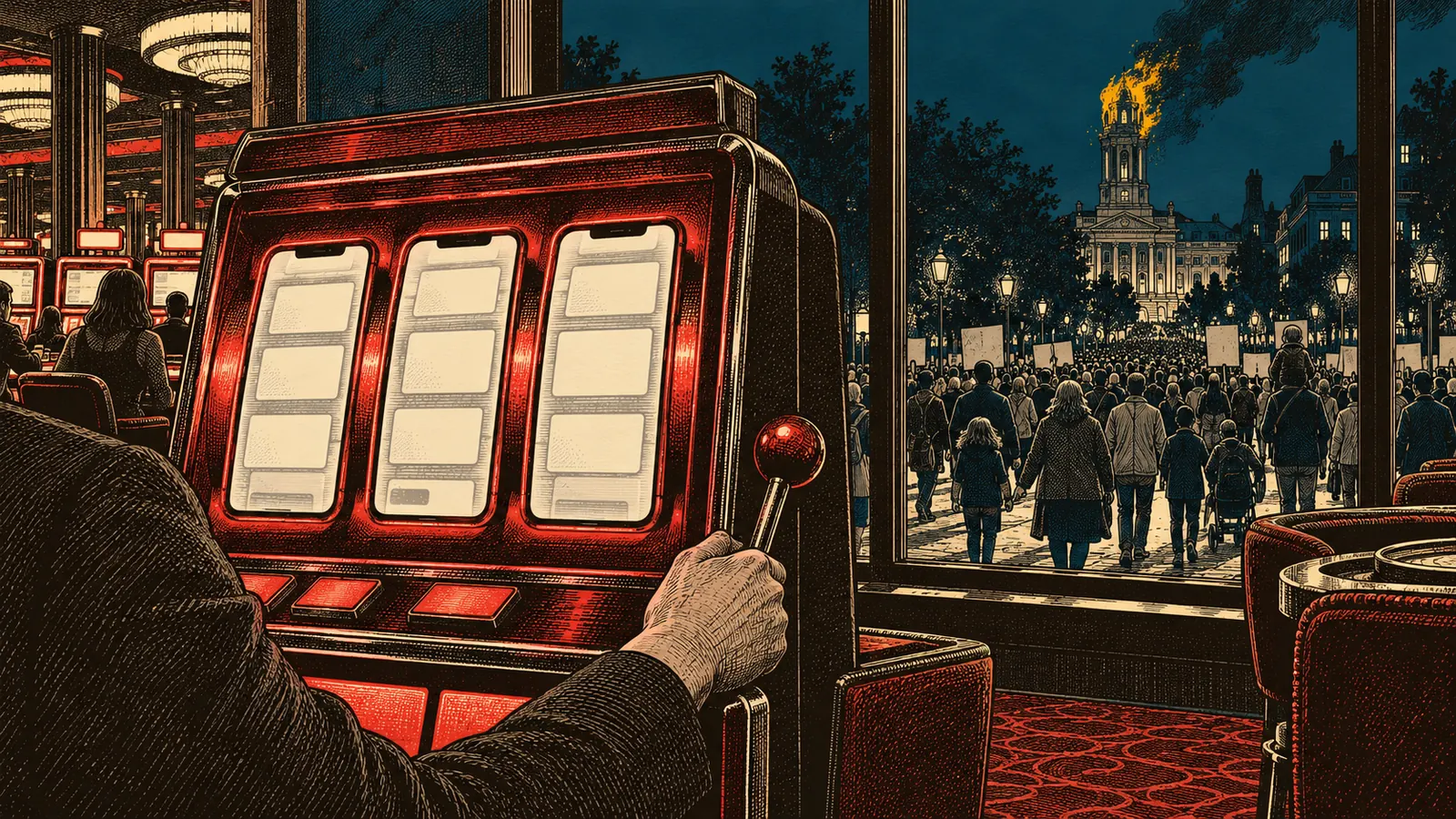
The casino floor,
where the measure is time on device.
Jacques-Yves Cousteau ran the Oceanographic Museum of Monaco from 1957 to 1988, on the Rock across the harbour from the Casino de Monte-Carlo. The casino trade has its own word for what it sells. It is not the jackpot. It is time on device: how long a player stays at the machine.
The anthropologist Natasha Dow Schüll spent some fifteen years among machine gamblers in Las Vegas and published the record in 2012 as Addiction by Design. It runs through game algorithms, machine ergonomics, casino architecture, what the trade calls “ambience management,” player tracking and cash access, all built to the market’s demand for maximum time on device. The players have a name for the state the machines produce: the machine zone, where money, worry and even the body fall away.
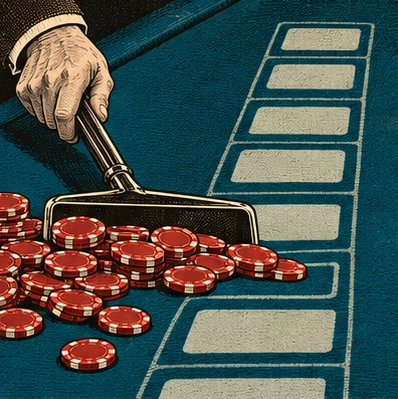
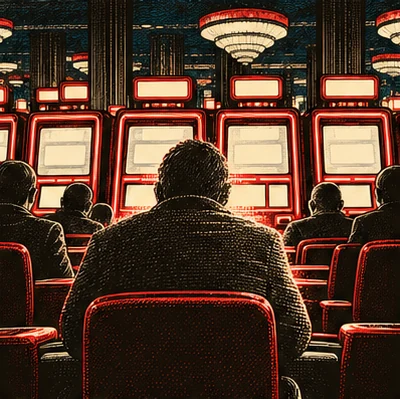
The machines carry the floor. In the United States they bring in upwards of three-quarters of gambling revenue, and even in the destination-resort casinos twice as much as every other game put together. Government-commissioned studies in the United States, Canada and Australia put the share of slot revenue that comes from problem gamblers at between 30 and 60 per cent.
The adult trade built the other half of the plumbing. In the early web, when buyers were wary of typing a card number into a browser, it developed the fraud controls that made card payments online workable, and its own processors, CCBill, Epoch and Verotel. It was among the first to stream video inside the page.
A game company
on Facebook, 2009–2012.
From the casino floor the game moved into the phone, and the house that took the cut was Facebook. FarmVille opened on Facebook in June 2009 and became the most popular social game on the platform. In March 2010 it had 83.76 million players a month, 34.5 million of them every day. Its maker, Zynga, also ran Zynga Poker, and players bought the in-game currency with real money. Zynga’s own filing to go public, in 2011, said it made substantially all of its revenue through Facebook.
The money ran both ways. Facebook filed to go public on 1 February 2012 and listed Zynga as a risk to its business. Zynga accounted for about twelve per cent of Facebook’s 2011 revenue, some 445 million dollars out of 3.7 billion. Almost all of it sat in the line Facebook called Payments: its cut of the virtual currency.
The builders named the design. Sean Parker, Facebook’s first president, said in November 2017 that the platform ran on “a social-validation feedback loop … exactly the kind of thing that a hacker like myself would come up with, because you’re exploiting a vulnerability in human psychology.” The inventors, he said, “understood this consciously. And we did it anyway.” Tristan Harris, trained in Stanford’s Persuasive Technology Lab and later Google’s design ethicist, put it in one sentence: “Every time I check my phone I’m playing the slot machine to see what I’m going to get.”
The ranking was tuned the same way. From 2017, Facebook’s internal documents show, the feed counted an emoji reaction, the angry one included, as worth five likes. A staff member warned in writing that favouring controversial posts could open “the door to more spam/abuse/clickbait.” The company’s later data found that posts drawing the angry reaction were disproportionately likely to carry misinformation, toxicity and low-quality news.
The table has since moved onto the news itself. On prediction markets, anyone can buy a contract on an election, a match or an event. In July 2026 Kalshi and Polymarket together traded a record of about 50.6 billion dollars, most of it on sport, which has made up 80 per cent of Kalshi’s volume since July 2024. Washington regulates them as commodity derivatives. On 25 September 2026 a federal appeals court ruled that Ohio and Tennessee may regulate them as gambling; Arizona has filed criminal charges against Kalshi, and New York has sued Polymarket as an unlicensed gambling operation.
Six prime ministers,
one general election.
Played at the screen, people kept voting. The office passed from hand to hand inside the parties anyway. Since July 2016 Britain has had six prime ministers: Theresa May, Boris Johnson, Liz Truss, Rishi Sunak, Keir Starmer and Andy Burnham. Five of them took office through a vote inside their own party. Starmer is the one who came in through a general election, on 5 July 2024. After Burnham won a seat in Makerfield this year, Labour MPs moved against Starmer, and on 22 June 2026 he announced he would stand down. Burnham was the only candidate with enough support from the party’s MPs. He became leader on 17 July and prime minister on 20 July, with no contest and no general election.
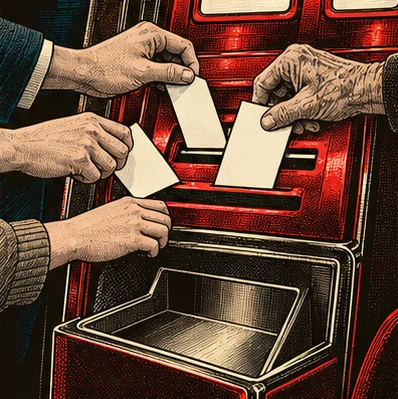
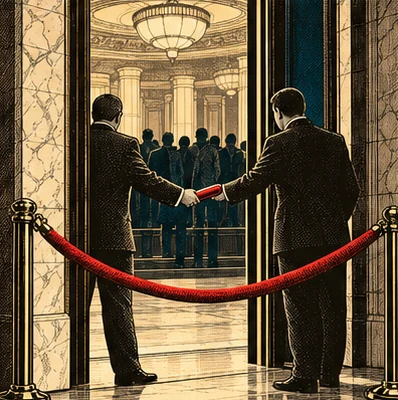
In France, Emmanuel Macron dissolved the National Assembly in June 2024. The left alliance, the Nouveau Front populaire, won the most seats on 7 July and put forward Lucie Castets as prime minister. On 26 August Macron declined to appoint her, and on 5 September he named Michel Barnier. On 4 December 2024 the Assembly brought Barnier down, 331 deputies out of 577, the first government censured since 1962. François Bayrou followed on 13 December and lost a confidence vote on 8 September 2025. Sébastien Lecornu, named the next day, is the fourth prime minister since the snap election, and he pushed the 2026 budget through parliament.
The rest of the G7 has the same pattern. In Japan, Shigeru Ishiba took office on 1 October 2024 and Sanae Takaichi on 21 October 2025, each chosen by the governing party before any voter was asked. In Germany, Olaf Scholz’s coalition collapsed on 6 November 2024, and Friedrich Merz has been chancellor since 6 May 2025. In Canada, Justin Trudeau announced his resignation in January 2025, and the Liberal Party chose Mark Carney, who became prime minister on 14 March.
Voters have answered at the ballot box. In 2024, every governing party in the developed world that faced a national election lost vote share, the first time that had happened in records going back to 1905. The OECD’s trust survey, published in June 2026, found 40 per cent of people with high or moderately high trust in their national government and 43 per cent with low or none.
Rent, bread and schools,
August 2021 to August 2026.
The bill went to the people who never sat at the table. Food and non-alcoholic drink in the European Union cost 34 per cent more in August 2026 than in August 2021, by Eurostat’s figures. Over the same five years, the food that a gross monthly minimum wage can buy fell by five per cent in Spain and four per cent in France.
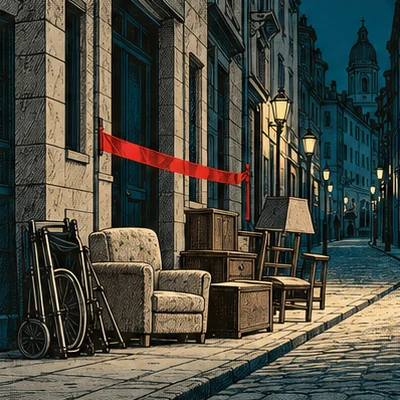
In Madrid, María del Carmen Abascal, known as Maricarmen, had lived in her flat in the Retiro district for seven decades. She was 87 and used a wheelchair. The investment company that owned the building raised her rent from 500 euros a month to 2,650. On 23 September 2026 police cordoned off the street, removed the people standing at her door, and she was carried out on a stretcher. Tents went up in the Puerta del Sol. She died in a Madrid hospital on 7 October.
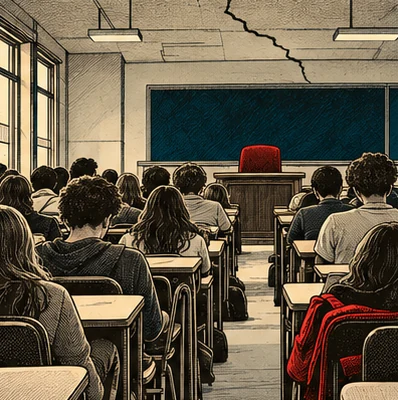
In Créteil, outside Paris, pupils at the Lycée Antoine-de-Saint-Exupéry walked out in the third week of September. The high-school union, the Union syndicale lycéenne, set out four grievances: missing teachers and staff, crumbling buildings, overloaded timetables in classes of 32 to 36, and the stress of Parcoursup, the national university admissions system. By 1 October the Interior Ministry counted 1,027 lycées affected and 222 blockaded.
The bill comes due:
eleven dates, autumn 2026.
Every stop below is a dated entry from the public record. Drag through them and watch the places light up, the official count of people in the street, and the line at the bottom: what has been conceded on the demands that started it.
Crowd figures are the French Interior Ministry’s, with the organisers’ figure beside it where one was published. Dates after 19 October are the calls and the election already set.
That is the shape of the autumn. Three countries in the first two weeks, then the marches doubling, then a single Saturday on which France counted 550,000 people in the street, Italy fought in three cities, and Montreal stood in Phillips Square. On the demands that started it, rent and teachers and buildings, the record through 19 October shows one measure: 3,000 substitute teachers sent to the worst-hit French schools.
17 October:
the town halls.
Played, overruled and billed, people went into the street. On Saturday 17 October the French Interior Ministry counted 550,000 people in 110 marches across the country; the organisers counted 800,000. In Limoges, protesters entered the town hall in the late afternoon. The fire took the roof, and the campanile, the bell tower that is the emblem of the city, collapsed. The building was inaugurated in 1883 and listed as a historic monument in 1975.
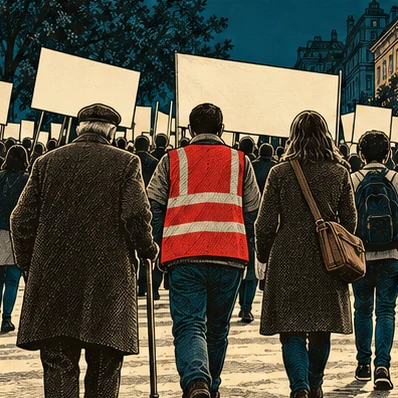
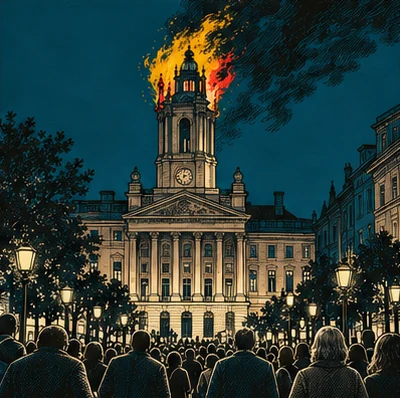
In Marseille, protesters broke the door of the town hall and went inside chanting “on prend la Bastille”: we are taking the Bastille. In Lille they forced several entrances to the town hall. In Lyon the tourist office on the place Bellecour was set alight. In Paris, two people climbed the statue on the place de la République and dressed it in a yellow vest, and shops were looted in the streets between République and Bastille. Over the weekend the Interior Ministry recorded nearly 2,400 arrests and nearly 1,000 police officers and gendarmes injured. The chambers of commerce counted more than 2,000 businesses hit.
The same day in Milan, a cost-of-living march set off peacefully and ended with barricades of bar tables on fire. The next morning via Dante, via Torino and via Orefici were strewn with bins, scooters and bicycles; riot police charged as far as the Galleria Vittorio Emanuele II, and two metro lines were closed. Turin and Bologna had clashes too, and 141 officers were injured across Italy. Giorgia Meloni called a meeting on public order. Milan’s mayor, Giuseppe Sala, said the reasons for the protests were understandable. In Montreal, students and unions gathered in Phillips Square over rent, groceries, unpaid internships and tuition.
- The gilets jaunes, back in their yellow vests
- Union confederations: CGT, FO, UNSA, CFDT, Solidaires, CFTC and the Confédération paysanne
- Teachers’ unions FSU and SNALC
- High-school and university students
- Workers, renters and pensioners against the cost of living and the cuts to public services
The arrest figures are mostly minors. By mid-October more than 6,800 people had been taken into custody in France, most of them under eighteen, and most were released without charge. The marches were wider than that. In Spain the movement began with an 87-year-old. In France the march of 17 October was called against the cost of living as well as the state of the schools, and it brought the gilets jaunes, every major union confederation, students, teachers and workers into the same streets.
On 19 October Prime Minister Lecornu asked the prefects for “partial” and “localised” curfews and said a state of emergency could be declared if necessary. Marseille banned gatherings from noon to eight in the evening. Macron said, “We all feel anger and shame,” and kept his trip to the Gulf. The mayor of Paris, Emmanuel Grégoire, asked the prime minister to open negotiations with the student and employee organisations. No concession was announced. The gilets jaunes called the next national day for 24 October. In Spain the unions back a general strike over housing on 11 November, and Pedro Sánchez has called a general election for 29 November.
At 9:59 on the morning of 18 October, New York time, Polymarket opened a market titled France declares state of emergency by…? By 19 October it had traded about 51,000 dollars, with the contract for 31 December priced at 22 cents.
Back on deck:
what the log supports.
Played. The tools that hold attention were built by trades that measure success in time spent: the casino floor, whose machines out-earn every other game combined, and the adult web, which made the card payment and the in-page video work. Facebook brought a game company inside its feed and took a cut of the currency: twelve per cent of its 2011 revenue came from Zynga. It weighted an angry reaction at five likes. Its first president said the people who built it understood what they were exploiting and did it anyway. Prediction markets now take bets on the news itself: about 50.6 billion dollars in July 2026.
Overruled. Office in the G7 has changed hands mostly inside the house. Five of Britain’s last six prime ministers were chosen by their party, the latest without a contest. France is on its fourth prime minister since an election whose largest bloc was refused the post. In 2024 every governing party that faced the voters lost ground, and in 2026 more people distrust their national government than trust it.
Billed, and in the street. Food costs a third more than five years ago, and a pensioner’s rent went from 500 euros to 2,650. From late September the marches spread from Créteil and Madrid to Milan, Liège, Athens and Montreal, and on 17 October the town hall of Limoges burned. Through 19 October the answer on the demands themselves was 3,000 substitute teachers, curfews, and an election in Spain.
Across the harbour from the museum, the casino never closes.
The house keeps the edge: on the floor, in the feed, in the cabinet.
In October 2026 the bill came due in the street, and the bell tower of Limoges came down.
The next morning, the house opened a book on whether France would declare a state of emergency.

Where to check
every line above.
Grouped by the section each one supports.
i. The house
- Natasha Dow Schüll, Addiction by Design: Machine Gambling in Las Vegas, Princeton University Press, 2012: time on device, the design levers, the machine zone.
- Natasha Dow Schüll, article in Risk&Regulation, LSE Centre for Analysis of Risk and Regulation, 2013: machines at upwards of three-quarters of American gambling revenue and twice all other games combined; problem gamblers at 30 to 60 per cent of slot revenue.
- “When Sex Drives Technological Innovation”, American Heritage: online card-fraud controls and payment processors.
- “Porn pioneers”, The Next Web, 30 August 2016: CCBill, Epoch, Verotel; streaming video in the page.
ii. The table inside the feed
- FarmVille: launch in June 2009; 83.76 million monthly and 34.5 million daily players, March 2010.
- Zynga Inc., Form S-1, 2011: substantially all revenue through Facebook.
- “Zynga generated $445m for Facebook in 2011”, MCV, and “Facebook depends on Zynga for 12% of revenue”, SlashGear, February 2012, from Facebook’s Form S-1 of 1 February 2012.
- Mike Allen, “Sean Parker: Facebook was designed to exploit human vulnerability”, Axios, 2017.
- “Former Google product philosopher thinks technology is purposely addictive”, InsideHook: Tristan Harris, the Persuasive Technology Lab, the slot machine.
- “Kalshi and Polymarket’s combined volume reaches all-time high in July”, The Block, August 2026: about 50.6 billion dollars.
- “Kalshi vs Polymarket”, MetaMask, citing Pew Research Center: sport at 80 per cent of Kalshi’s volume since July 2024.
- “US court rules against Kalshi, says states can regulate prediction markets”, Al Jazeera, 25 September 2026: the Sixth Circuit, Ohio and Tennessee, and New York’s suit against Polymarket; Arizona’s charges against Kalshi.
- Jeremy B. Merrill and Will Oremus, “Five points for anger, one for a ‘like’”, The Washington Post, 26 October 2021.
iii. The relay
- “Why Britain is getting a new prime minister without a general election”, AP via PBS NewsHour, July 2026; 2026 Labour Party leadership election.
- “Who is François Bayrou”, Al Jazeera, 13 December 2024: Barnier censured, 331 of 577.
- Bayrou government; “French PM Lecornu rams 2026 budget through parliament”, Courthouse News.
- “2024 was a historic year for global elections, and a bad one for those in power”, NBC News, from the Financial Times analysis by John Burn-Murdoch.
- OECD, “Trust steadies but people still do not feel heard”, June 2026.
iv–vi. The bill, the instrument and Limoges
- “Wages vs prices”, Euronews, 19 October 2026, from Eurostat: food prices and minimum-wage purchasing power.
- “Maricarmen: evicted 87-year-old who became a symbol of Spain’s housing crisis has died”, CNN, 7 October 2026; NPR, 28 September 2026.
- “Tens of thousands protest in Spain after failed housing reforms”, Al Jazeera, 3 October 2026; Sánchez calls an election for 29 November, Euronews, 5 October 2026.
- 2026 French student protests: Créteil, the four grievances, the lycée counts, the turnout by date, the 3,000 substitute teachers, the custody totals.
- Nicholas Bequelin, “Why is France burning?”, TIME, 16 October 2026: custody of minors and release without charge.
- Place de la Bastille, 8 October, Euronews.
- “La mairie de Limoges toujours en feu, le campanile s’est effondré”, France 3, 17 October 2026; franceinfo, 18 October 2026; Hôtel de Ville, Limoges.
- L’Avenir, 17 October 2026: Marseille, Lille, Lyon, République, who marched.
- France 24, 19 October 2026: the weekend totals, curfews, Macron, Grégoire, 24 October.
- Euronews, 18 October 2026, and L’Unione Sarda: Milan, Turin, Bologna, Meloni, Sala.
- Polymarket, “France declares state of emergency by…?”, opened 18 October 2026, read 19 October.
- CBC Montreal, 17 October 2026: Phillips Square.
Visual direction after the oceanographic films of Jacques-Yves Cousteau and the crew of the R.V. Calypso, 1943–1996. The saucer is the SP-350 “Denise”. No affiliation; the debt is the point.